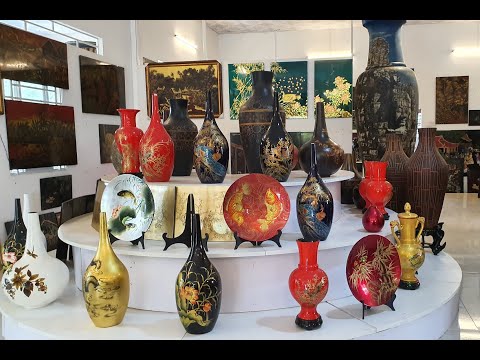
Tuong Binh Hiep Lacquerware Craft
In the quiet workshops of Tuong Binh Hiep village, the air shimmers with the scent of tree sap and ancient secrets. Here, artisans' hands move with the patience of centuries, layering liquid gold onto humble wood, transforming the ordinary into objects that gleam like captured moonlight. Each brushstroke whispers stories of Vietnamese royalty, while the rhythmic tapping of bamboo tools creates a meditation that has echoed through generations.
Tuong Binh Hiep lacquerware represents one of Vietnam's most refined traditional crafts, where the ancient art of sơn mài (lacquer painting) reaches its pinnacle of sophistication. Located in Binh Duong province, this village has been the guardian of lacquerware techniques that transform simple wooden objects into lustrous masterpieces adorned with mother-of-pearl inlays, creating functional art that embodies Vietnamese aesthetic philosophy and cultural heritage.
The Golden Threads of Royal Heritage
The story of Tuong Binh Hiep lacquerware begins in the mists of Vietnamese antiquity, when the discovery of lacquer tree sap (cây sơn) revolutionized decorative arts. Legend speaks of ancient craftsmen who first noticed how the milky resin from Toxicodendron succedaneum trees could be transformed into a protective, lustrous coating that seemed to capture light itself.
During the Nguyen Dynasty (1802-1945), lacquerware production flourished under royal patronage. The imperial court's demand for exquisite decorative objects elevated the craft from utilitarian necessity to high art. Tuong Binh Hiep village emerged as a center of excellence, where master artisans developed techniques so refined that their works adorned the palaces of Hue and the homes of the Vietnamese elite.
The French colonial period brought new influences and markets, as European collectors became enchanted with Vietnamese lacquerware's unique beauty. This cross-cultural appreciation helped preserve and evolve the craft, ensuring its survival through the turbulent decades of the 20th century.
The Alchemy of Patience and Precision
Creating authentic Tuong Binh Hiep lacquerware is an exercise in meditative precision that can take months to complete a single piece. The process begins with selecting the perfect wood base, typically crafted from gỗ mít (jackfruit wood) or gỗ gụ (sindora wood), chosen for their stability and fine grain.
The lacquering process unfolds in carefully orchestrated stages:
• Base preparation: The wooden form is sanded to silk-smooth perfection and sealed with initial coats of raw lacquer • Layer building: Up to 15-20 thin coats of sơn ta (Vietnamese lacquer) are applied, with each layer dried and polished before the next • Design creation: Master artisans sketch intricate patterns using traditional motifs like dragons, phoenixes, lotus flowers, and geometric patterns • Mother-of-pearl inlay: Fragments of xà cừ (mother-of-pearl) are meticulously cut and embedded into the lacquer surface • Final polishing: The completed piece undergoes extensive hand-polishing with fine abrasives until it achieves its characteristic mirror-like finish
The sơn mài technique requires extraordinary skill in color mixing, as artisans blend natural pigments with lacquer to create deep, luminous hues. Traditional colors include đỏ son (vermillion red), đen son (lacquer black), and vàng son (golden yellow), each carrying symbolic meaning in Vietnamese culture.
Mirrors of Vietnamese Soul and Philosophy
Tuong Binh Hiep lacquerware transcends mere decoration to become a reflection of Vietnamese spiritual and aesthetic values. Each piece embodies the Buddhist concept of patience and gradual perfection, where beauty emerges through countless small, mindful actions rather than dramatic gestures.
The traditional motifs carry profound cultural significance. Dragons represent imperial power and good fortune, while phoenixes symbolize grace and renewal. Lotus flowers, emerging pristine from muddy waters, reflect the Buddhist ideal of spiritual purity arising from worldly challenges. These symbols transform functional objects into meditation aids and cultural touchstones.
The craft also represents Vietnamese resilience and adaptability. Through centuries of foreign influence and political upheaval, lacquerware artisans preserved their techniques while incorporating new elements, creating a living tradition that honors the past while embracing evolution.
In Vietnamese homes, lacquerware pieces serve as family heirlooms passed down through generations, carrying not just beauty but memories and cultural identity. The lustrous surfaces seem to hold the reflections of countless family gatherings, celebrations, and quiet moments of daily life.
Journey to the Heart of Vietnamese Craftsmanship
Tuong Binh Hiep Village Experience
Visiting Tuong Binh Hiep offers travelers an intimate glimpse into Vietnam's artisanal soul. Located approximately 30 kilometers from Ho Chi Minh City, the village maintains its traditional character despite modern development pressures.
The best time to visit is during the dry season (November to April), when workshops operate at full capacity and the humidity doesn't interfere with the delicate lacquering process. Many family workshops welcome visitors, offering demonstrations of the intricate techniques passed down through generations.
Workshop Visits and Learning Opportunities
Several master craftsmen offer hands-on experiences where visitors can try their hand at basic lacquering techniques. These sessions provide profound appreciation for the skill and patience required, as even simple tasks like applying an even coat of lacquer prove surprisingly challenging.
The Nguyen Van Duc Workshop and Traditional Lacquer Art Center are particularly renowned for their educational programs, where visitors can observe the complete process from raw wood to finished masterpiece.
What to Expect and Bring Home
Authentic Tuong Binh Hiep lacquerware ranges from small decorative boxes and jewelry containers to elaborate room screens and furniture pieces. Prices reflect the intensive labor involved, with simple pieces starting around $20-30 and elaborate artworks commanding hundreds of dollars.
When purchasing, look for the telltale signs of authentic craftsmanship: perfectly smooth surfaces, intricate mother-of-pearl work that lies flush with the lacquer, and the characteristic deep luster that seems to glow from within. Genuine pieces will have slight variations that reveal their handmade nature, distinguishing them from machine-produced imitations.
The village also offers lacquerware maintenance services, teaching visitors how to care for their purchases to ensure they maintain their beauty for generations to come.
Featured Video
Làng sơn mài Tương Bình Hiệp-Tuong Binh Hiep lacquer village-05
Heritage Details
Official Recognition Information
- Official Name (Vietnamese)
- Nghề sơn mài ở Tương Bình Hiệp
- Description
- The exquisite Tuong Binh Hiep lacquerware craft, a centuries-old tradition hailing from Vietnam's Binh Dinh Province, showcases the intricate fusion of natural materials, skilled craftsmanship, and the cultural essence that defines this revered national heritage.